Preterm labor is an obstetrical emergency. It is imperative to
prevent early delivery of the fetus to reduce neonatal mortality. Preterm
labor is an obstetrical condition that I have personal experience with.
My first child was born at 35 weeks and my second child was born at 34
weeks.
Preterm labor is defined as contractions and cervical change anytime
after 20 weeks and up to 37 weeks gestation. Preterm birth is the
number one cause of neonate mortality (Lippincott Manual of Nursing Practice 2010). There has been a dramatic
increase in preterm births in the last 20 years in developed countries.
The World Health Organization equates links to this increase in the
technological advances in the last 20 years as well. The date of the
last menstrual period was used in the past to determine approximate
gestational age. Ultrasound is now a standard practice to take
measurements of the fetus and establish a gestational age and due dates
are adjusted with this advanced technology. This dramatic change in
prenatal care could equate for the larger numbers of births labeled as
preterm. Woman are having babies at much older ages. Fertility drugs
are more frequently used. Caesarean section deliveries also contribute to the higher statistics of PTL. Preterm birth
also is the main contributor of morbidities such as cerebral palsy,
heart defects, chronic lung diseases, and neurological deficits (Cooper,
2010). The medical costs involved in preterm birth compared to a
regular, full term delivery are dramatically higher. “Estimates indicate
that in 2005 the costs to the United States of America alone in terms
of medical and educational expenditure and lost productivity associated
with preterm birth were more than US$ 26.2 billion. The use of modern
technology allows survival of many preterm neonates in developed
countries, but such care is not widely available in developing
countries”
(http://www.who.int/bulletin/volumes/88/1/08-062554/en/ 2009).
(http://www.who.int/bulletin/volumes/88/1/08-062554/en/ 2009).
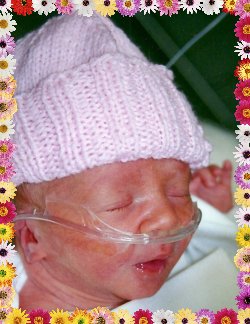
Katherine Ann Olswang, born at 34 weeks.
The exact causes of preterm labor remain unknown.
As in my case, having a history of a preterm birth triples your risk of having another preterm birth.
Other risk factors for PTL are:
Other risk factors for PTL are:
Hypertension Diabetes
Anemia Multiple gestation Placenta previa Abruptio placentae Infection Cervical incompetence UTIs | Mother < 17 or > 35 yrs old
Low socioeconomic status Smoking Air pollution Stress Long working hours Black race (double risk) (Lippincott Manual of Nursing Practice 2010) |
Certain pathological changes do occur with PTL. The cervix does shorten and soften, just as in a full term birth. Levels of the hormone prostaglandin increase within the amniotic fluid and oxytocin receptor are found in the myometrium (Lippincott Manual of Nursing Practice 2010). The uterus should be in a relaxed state during pregnancy. Many hormones and proteins are responsible for this. Relaxin, parathyroid hormone, prostacyclin and namely progesterone, to name a few, are all needed to keep the balance of the pregnancy intact. The causes of the uterus to begin to contract with constant activity are stimulated by the release of prostaglandins and oxytocin. Progesterone is the main hormone that inhibits the effects of oxytocin, keeping the uterine muscles relaxed thus preventing labor. Progesterone has been greatly studied for this reason as a hope that it may be the key in preventing PTL. It is known that when serum levels of progesterone decrease, estrogen levels increase and the process of labor begins. What is mystifying is what exactly signals the fetus to activate this labor process (Cooper, 2010).
Medical treatments to prevent or even delay a preterm birth are done but without much evidence that any of them are effective. Basic interventions are bed rest, increase fluids and refrain from intercourse. To reduce the risk of natural oxytocin from being produced by the mother, she should refrain from any type of nipple stimulation. As UTIs are a cause of PTL, they should be treated early with antibiotic therapy. Antibiotics are also necessary for prenatal group B streptococcal prevention. Other interventions that are modifiable lifestyle choices are: to stop smoking, eat frequent small meals while maintaining appropriate weight gain, tight control of diabetes and stress reduction. Conditions that are not modifiable are race, age and previous preterm pregnancies. This high risk patient requires teaching on the importance of frequent prenatal care visits. There are markers present in the mother can be tested for to insinuate the possibility of a preterm birth. One of the main markers is a protein called Fetal Fibronectin (fFN). This protein is present in the first ½ of the pregnancy and should not return until after approximately 34 weeks. If the fFN test is positive, it is a sign that the mucous membrane lining of the uterus is separating and a preterm birth is highly probable.
If PTL is probable, corticosteroids can be administered. Dexamethasone or Betamethasone is given to the mother, generally between 24-36 weeks’ gestation. The steroids aid in the acceleration of development of the fetal lung tissue. For the mother that proceeds into labor prior to 37 weeks, tocolytic therapy is often prescribed. There are contraindications for the use of the tocolytics, such as eclampsia. Other contraindications are a mothers with severe bleeding, fetal demise or cervical dilation that has progressed to far already. Betamimetic-Terbutaline acts on smooth muscle cells and is used to decrease uterine contractions. MgSO4 interferes with smooth-muscle contractility to aid in slowing uterine contractions. As these medicines are acting on the smooth muscles in the uterus, they are also acting on other smooth muscles in the mother’s body. The smooth muscle fibers found within the aorta, lungs, arteries and veins can put the mother at risk of tachycardia, hypotention, respiratory complications and cardiac arrhythmias. Indocin which is a prostaglandin inhibitor slows stimulation of contractions. This medicine has the potential for adverse effects on the fetus, especially after 34 weeks gestation. Calcium channel blockers such as Procardia are used to relax the smooth muscle thus relaxing the uterus muscles. Risks are high for hypotention in the mother.
The nursing goal of safe administration of medications ordered to prevent PTL would be paramount. Frequent assessment and readiness to implement interventions quickly are imperative for both the safety of the mother and the fetus. Most of the medications given for PTL are given in the hospital and done with cardiopulmonary monitoring. Education must be provided to the patient and possibly family on the signs and symptoms of the medications prior to administration. An IV site must be started and monitored during infusions to assess for signs of infiltration and possible venous tissue damage. Vitals signs are taken frequently to monitor for hypotention. Telemetry can be used to monitor for cardiac rhythm complications. The MD should be notified immediately if cardiac dysrhythmias occur. Input and output is monitored to ensure kidney perfusion. Deep tendon reflexes are also assessed with the MgSO4 infusion as signs of hyporeflexia can be a sign of magnesium toxicity. Mg+ lab values should be monitored. Lung sounds need to assessed prior to infusion to establish a base line and then periodically to assess for fluid shifts and possible pulmonary edema. The infusion should be stopped and the MD notified if these adverse reactions present. Continue to keep the IV open with a TKO rate to ensure rapid administration of fluid boluses and/or IV antidotes if they are indicated; such as calcium gluconate for magnesium toxicity.
Another nursing goal for the patient with possible PTL is to decrease anxiety and promote coping skills. The nurse actually has at least two patients. There is the mother, the fetus and most often, the father. There is also the likelihood of siblings and various other family members. Clear explanations of the tocolytic therapies should be given as well as possible side effects. Be sure the patient understands to alert the nurse of any of those side effects as soon as they occur. Educate the patient on the importance of pain control. Offer consults with other hospital personal to provide additional support, such as chaplain volunteers, auxiliary volunteers and MSW/RN case managers. If the patient is receiving care with a midwife as well as her OB MD, be sure that the midwife is called. Midwives often do not deliver during high-risk pregnancies but are available for direct bedside support. Facilitate open dialog with the patient and family in regards to their fears and concerns. Explain the labor process and provide information on the progression. Reinforce breathing, imagery and modes of relaxation. Encourage maternal positions that facilitate fetal perfusion. Avoid laying on the back/supine which compresses the vena cava. Encourage visits from the mothers other children as tolerated by her. Assess the mothers need for privacy and possible restrictions on visitors. If patient is to be discharged with home monitoring, ensure complete teaching and understanding on requirements of follow-up OB care, bed rest and signs and symptoms to monitor for at home. For the patient that continues to progress into full labor, the RN then assumes the roles of an active OB RN with continued coaching, pain control and active labor assessments and interventions.

